Polaroid and the camera for the analog life
A camera company decided its competition was not other cameras. It is one of several brands reading the same wave, and reading it early.
Ricardo, Founder · August 24, 2026 · 5 min read
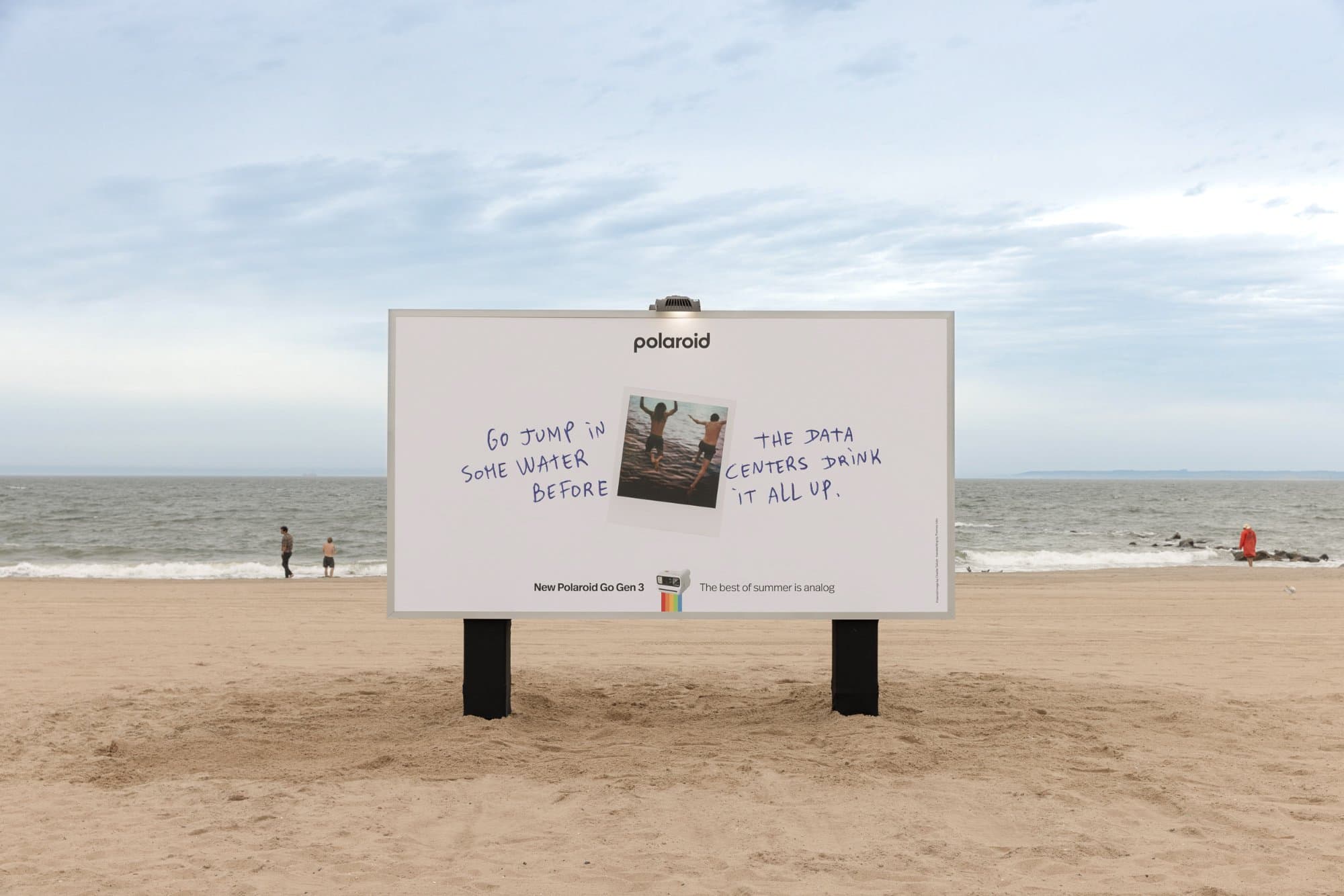
In July, Polaroid started buying outdoor advertising in New York and London, and put it next to Apple Stores and Google offices. Also JFK, also city centers, but the Apple Store placement is the part worth stopping on. That is not a media buy. That is a company standing outside its competitor's front door.
The lines read:
"No one on their deathbed ever said: I wish I'd spent more time on my phone."
"Remember that night we spent on our phones? Me neither."
"Real stories. Not stories & reels."
In August they ran phone-free walking tours in Paris, Tokyo and London. You get a Flip camera, you leave your phone, you mail the prints as postcards.
The whole thing was made in-house, by their own creative studio. No agency.
They decided their competition was not other cameras
Think about how rare that is.
Almost every analog company that got run over by software spent the following twenty years trying to become software. Kodak invented the digital camera and then spent a generation trying to survive it. Bookstores built apps. Newspapers built apps. The instinct is always the same: the thing killing you looks like the future, so you become a worse version of it.
Polaroid went the other way and made the constraint the product. One shot. No preview. No delete. It develops in front of you whether you like it or not.
Those were the reasons to buy a digital camera in 2004. They are the reasons to buy a Polaroid in 2026. Same object, opposite argument. The world moved and the object stayed still long enough to mean something else.
"It might not come out right" is the offer
This is the part we keep thinking about, because it is the boldest thing in the campaign and it is not in the copy at all. It is in the product.
A Polaroid can come out badly. Too dark, half a face, somebody's thumb. And it stays that way. You cannot check it, retake it, fix it in an app or quietly delete it and try again.
Every camera company for twenty years treated that as the problem to solve. More shots, better previews, undo, retouching, a burst of forty frames so one of them lands. Polaroid is out here selling the opposite: you get one, it costs something, and it might not work.
That is a genuinely brave thing for a large company to put on a billboard, because it means telling people the truth about the product instead of the fantasy. Not everything has to come out right. Not everything is for an audience. You do not need a thousand versions of one night.
And they are not the only ones reading this
The thing worth noticing is that this is not a camera story. It is happening everywhere at once.
Run clubs turned into how people meet. Dinner parties turned into the weekend. Cookbook clubs, book clubs that actually meet, supper clubs with a name and a next date. Vinyl. Print. Film. Disposable cameras at weddings again. None of these are efficient and that is the entire appeal.
Brands are catching it. Heineken and Cadbury are both running work that sells itself on being made by people. H&M and Guess took a beating for using AI models instead of humans. There is now a small group of companies treating "a person made this" the way a label treats organic or fair trade: a fact worth printing.
And underneath all of it, a finding that should interest anyone who makes anything. Show people the same piece of work twice, telling them once that a person made it and once that a machine did, and they rate it higher when they believe it was a person. Same pixels. The label changes the experience of the thing.
Which means how something was made is not marketing wrapped around a product. It is part of the product.
What we think is actually happening
People are not turning against technology. Nobody is giving up their phone, and Polaroid is not asking them to.
What is happening is that people are sorting out which parts of their lives should be frictionless and which parts should not. Getting a ride, paying a bill, finding the address: frictionless, obviously, and nobody wants that back. But the part where something matters to you, the part you will talk about later, that part is starting to feel wrong when it is too easy.
Effort has quietly become the signal. When everything can be generated instantly and infinitely, the only thing left that proves somebody meant it is that it cost them something to do.
That is why the one-shot camera is back. That is why people are cooking for each other on a Tuesday instead of meeting at a bar.
We are making the same bet
It is why we make a physical book.
Recipes from the people in someone's life, printed, bound, sitting in a kitchen and slowly getting ruined by being used. It does not update. It cannot be scrolled. It has one version, and somebody has to walk over and open it.
And the reason it lands is the same reason a Polaroid lands: everyone in it had to stop and do something. Write down the dish they are known for. Think about how they actually make it. Five minutes of real effort, from a real person, that nothing can generate on their behalf.
Polaroid figured out that the constraint was the product. We think that is the same bet, in a different aisle.
The interesting question for the next few years is which companies keep the slow, expensive, unrepeatable parts of what they make when a much cheaper version is available on every screen. Polaroid just bet a campaign on it, standing outside the Apple Store. That is a real position, and real positions are getting rare.